Foi lançada a nova versão do Ubuntu, 10.04 LTS - Lucid Lynx, com o Gnome 2.30.0.
Gostei que o Nautilus, que agora vem com opção de um painel de navegação extra (F3), mas a barra de localização por onde podemos digitar caminhos (diretórios) a percorrer com recurso de autocompletar não é padrão (default) e nem aparece o ícone para trocar o tipo de navegação: digitando caminhos ou clicando em botões como nomes dos diretórios. Para habilitar isso, temos duas opções:
a) Basta dar Ctrl + L -- O Ctrl+L funciona, mas, a cada sessão aberta do Nautilus, têm-se que repetir esse comando.
b) Pode-se fazer isso pelo Gconf-editor. Dê um Alt+F2, digite: gconf-editor. Abra (na "cruzinha") apps, depois nautilus e, por último, preferences. Aí, é só marcar a opção "always_use_location_entry". Pronto.
terça-feira, 18 de maio de 2010


segunda-feira, 5 de abril de 2010
Java: Types of Exception
Exception come is several flavours: RuntimeExceptions, Errors, Checked and Unchecked.
Collectively, RuntimeException, Error and Exception are derived from Throwable. RuntimeException is derived from Exception, which is derived from Throwable. Error is derived directly from Throwable. If you catch RuntimeException you will catch all manner of run time Exceptions (type R).
If you catch Error you will catch all manner of errors (type E).
If you catch Exception you will catch all manner of checked Exceptions and run time Exceptions (type R+C).
If you catch Throwable, you will catch everything, (Type R+E+C );
If the Exception is checked, you must either fob it off on the caller, with the throws clause or catch it yourself. Unchecked Exceptions are ones like running out of RAM that, in general you can’t do much about, or that are not associated with specific problematic code, or that are very common such as IllegalArgumentException or NullPointerException. You don’t have to catch unchecked Exceptions or explicitly fob them off on the caller with throws. The classification of an Exception is not an exact science. It is a little bit like the arbitrary assignment of gender in French or German to objects. You just have to look it up. There is a major clue, Error Exceptions end in the string “Error” while checked Exceptions and RuntimeExceptions end in the string “Exception”.
| Type codes used in describing Exceptions | ||||
|---|---|---|---|---|
| Letter | Type | Parent Class | Checked? (declare throws?) | Use |
| R | Runtime | java.lang.RuntimeException | N | Error that can occur in almost any code e.g. NullPointerException. |
| E | Error | java.lang.Error | N | Serious error you really should not try to catch, e.g. OutOfMemoryError. |
| C | Checked | java.lang.Exception | Y | Likely exceptional condition that can only occur in specific places in the code e.g. EOFException. |
If you catch Error you will catch all manner of errors (type E).
If you catch Exception you will catch all manner of checked Exceptions and run time Exceptions (type R+C).
If you catch Throwable, you will catch everything, (Type R+E+C );
If the Exception is checked, you must either fob it off on the caller, with the throws clause or catch it yourself. Unchecked Exceptions are ones like running out of RAM that, in general you can’t do much about, or that are not associated with specific problematic code, or that are very common such as IllegalArgumentException or NullPointerException. You don’t have to catch unchecked Exceptions or explicitly fob them off on the caller with throws. The classification of an Exception is not an exact science. It is a little bit like the arbitrary assignment of gender in French or German to objects. You just have to look it up. There is a major clue, Error Exceptions end in the string “Error” while checked Exceptions and RuntimeExceptions end in the string “Exception”.
| Specific Exceptions | |||
|---|---|---|---|
| Exception Name | Type | Package | Notes |
| AbstractMethodError | E | java.lang | |
| AccessControlException | R | java.security | This is an exception that is thrown whenever a reference is made to a non-existent ACL (Access Control List). notes. |
| AccessException | C | java.rmi | Thrown by certain methods of the java.rmi.Naming class. |
| AclNotFoundException | C | java.security.acl | Thrown whenever a reference is made to a non-existent ACL (Access Control List). |
| ActivateFailedException | C | java.rmi.activation | thrown by the RMI runtime when activation fails during a remote call to an activatable object. |
| ActivationException | C | java.rmi.activation | |
| AlreadyBoundException | C | javax.naming | |
| ApplicationException | C | org.omg.CORBA.portable | Used for reporting application level exceptions between ORBs and stubs |
| ArithmeticException | R | java.lang | Most commonly a divide by zero. notes. |
| ArrayIndexOutOfBoundsException | R | java.lang | Can be handled more generically with IndexOutOfBoundsException. notes. |
| ArrayStoreException | R | java.lang | Thrown to indicate that an attempt has been made to store the wrong type of object into an array of objects. notes. |
| AttributeInUseException | C | javax.naming.directory | |
| AttributeModificationException | C | javax.naming.directory | |
| AuthenticationException | C | javax.naming | |
| AuthenticationNotSupportedException | C | javax.naming | |
| AWTError | E | java.awt | |
| AWTError | E | java/awt | |
| AWTException | C | java.awt | |
| BadLocationException | C | javax.swing.text | This exception is to report bad locations within a document model. |
| BatchUpdateException | C | java.sql | |
| BindException | C | java.net | Signals that an error occurred while attempting to bind a socket to a local address and port |
| CannotProceedException | C | javax.naming | |
| CannotRedoException | R | javax.swing.undo | |
| CannotUndoException | R | javax.swing.undo | |
| CertificateEncodingException | C | java.security.cert | |
| CertificateException | C | java.security.cert | |
| CertificateExpiredException | C | java.security.cert | |
| CertificateNotYetValidException | C | java.security.cert | |
| CertificateParsingException | C | java.security.cert | |
| ChangedCharSetException | C | javax.swing.text | |
| CharConversionException | C | java.io | |
| ClassCastException | R | java.lang | notes. |
| ClassCircularityError | E | java.lang | |
| ClassFormatError | E | java.lang | notes. |
| ClassNotFoundException | C | java.lang | notes. |
| CloneNotSupportedException | C | java.lang | |
| CMMException | R | java.awt.color | |
| CommunicationException | C | javax.naming | |
| ConcurrentModificationException | R | java.util | This exception may be thrown by methods that have detected concurrent modification of a backing object when such modification is not permissible, e. g. two threads modifying a HashMap simultaneously. notes. |
| ConfigurationException | C | javax.naming | |
| ConnectException | C | java.rmi | |
| ConnectIOException | C | java.rmi | |
| ContextNotEmptyException | C | javax.naming | |
| CRLException | C | java.security.cert | CRL (Certificate Revocation List) Exception. |
| DataFormatException | C | java.util.zip | |
| DigestException | C | java.security | |
| EmptyStackException | R | java.util | Thrown by methods in the Stack class to indicate that the stack is empty. Does not refer to the system stack. |
| EOFException | C | java.io | notes. |
| Error | E | java.lang | Catches any serious error such as OutOfMemoryError that you unlikely can recover from. |
| Exception | C | java.lang | generic. Catches any specify Exception plus general Runtime exceptions, but not Errors. |
| ExceptionInInitializerError | E | java.lang | notes. |
| ExceptionInInitializerError | E | java.lang | |
| ExpandVetoException | C | javax.swing.tree | |
| ExportException | C | java.rmi.server | |
| FileNotFoundException | C | java.io | |
| FontFormatException | C | java.awt | |
| GeneralSecurityException | C | java.security | |
| IllegalAccessError | E | java.lang | notes. |
| IllegalAccessException | C | java.lang | Thrown when an application tries to load in a class, but the currently executing method does not have access to the definition of the specified class, because the class is not public and in another package. |
| IllegalArgumentException | R | java.lang | Most common exception to reject a bad parameter to a method. |
| IllegalComponentStateException | R | java.awt | |
| IllegalMonitorStateException | R | java.lang | |
| IllegalPathStateException | R | java.awt.geom | |
| IllegalStateException | R | java.lang | Signals that a method has been invoked at an illegal or inappropriate time. |
| IllegalThreadStateException | R | java.lang | |
| ImagingOpException | R | java.awt.image | |
| IncompatibleClassChangeError | E | java.lang | notes. |
| IndexOutOfBoundsException | R | java.lang | Similar to ArrayIndexOutOfBoundsException for ArrayList. |
| IndirectionException | R | org.omg.CORBA.portable | |
| InstantiationError | E | java.lang | |
| InstantiationException | C | java.lang | |
| InsufficientResourcesException | C | javax.naming | |
| InternalError | E | java.lang | |
| InterruptedException | C | java.lang | Thrown when a thread is waiting, sleeping, or otherwise paused for a long time and another thread interrupts it using the interrupt method in class Thread. |
| InterruptedIOException | C | java.io | |
| InterruptedNamingException | C | javax.naming | |
| IntrospectionException | C | java.beans | |
| InvalidAlgorithmParameterException | C | java.security | This is a GeneralSecurityException. See IllegalArgumentException. |
| InvalidAttributeIdentifierException | C | javax.naming.directory | |
| InvalidAttributesException | C | javax.naming.directory | |
| InvalidAttributeValueException | C | javax.naming.directory | |
| InvalidClassException | C | java.io | notes. |
| InvalidDnDOperationException | R | java.awt.dnd | |
| InvalidKeyException | C | java.security | |
| InvalidKeySpecException | C | java.security.spec | |
| InvalidMidiDataException | C | javax.sound.midi | |
| InvalidNameException | C | javax.naming | |
| InvalidObjectException | C | java.io | |
| InvalidParameterException | R | java.security | |
| InvalidParameterSpecException | C | java.security.spec | |
| InvalidSearchControlsException | C | javax.naming.directory | |
| InvalidSearchFilterException | C | javax.naming.directory | |
| InvalidTransactionException | C | javax.transaction | |
| InvocationTargetException | C | java.lang.reflect | |
| IOException | C | java.io | |
| JarException | C | java.util.jar | |
| KeyException | C | java.security | |
| KeyManagementException | C | java.security | |
| KeyStoreException | C | java.security | |
| LastOwnerException | C | java.security.acl | |
| LdapReferralException | C | javax.naming.ldap | |
| LimitExceededException | C | javax.naming | |
| LineUnavailableException | C | javax.sound.sampled | |
| LinkageError | E | java.lang | |
| LinkException | C | javax.naming | |
| LinkLoopException | C | javax.naming | |
| MalformedLinkException | C | javax.naming | |
| MalformedURLException | C | java.net | |
| MarshalException | C | java.rmi | |
| MidiUnavailableException | C | javax.sound.midi | |
| MimeTypeParseException | C | java.awt.datatransfer | |
| MissingResourceException | R | java.util | |
| NameAlreadyBoundException | C | javax.naming | |
| NameNotFoundException | C | javax.naming | |
| NamingException | C | javax.naming | |
| NamingSecurityException | C | javax.naming | |
| NegativeArraySizeException | R | java.lang | |
| NoClassDefFoundError | E | java.lang | notes. |
| NoInitialContextException | C | javax.naming | |
| NoninvertibleTransformException | C | java.awt.geom | |
| NoPermissionException | C | javax.naming | |
| NoRouteToHostException | C | java.net | |
| NoSuchAlgorithmException | C | java.security | |
| NoSuchAttributeException | C | javax.naming.directory | |
| NoSuchElementException | R | java.util | |
| NoSuchFieldError | E | java.lang | |
| NoSuchFieldException | C | java.lang | |
| NoSuchMethodError | E | java.lang | notes. |
| NoSuchMethodException | C | java.lang | |
| NoSuchObjectException | C | java.rmi | |
| NoSuchProviderException | C | java.security | notes. |
| NotActiveException | C | java.io | Thrown when serialization or deserialization is not active |
| NotBoundException | C | java.rmi | |
| NotContextException | C | javax.naming | |
| NotOwnerException | C | java.security.acl | |
| NotSerializableException | C | java.io | notes. |
| NullPointerException | R | java.lang | Actually a null reference exception. notes. |
| NumberFormatException | R | java.lang | Commonly thrown when a String is converted to internal binary numeric format. notes. |
| ObjectStreamException | C | java.io | |
| OperationNotSupportedException | C | javax.naming | |
| OptionalDataException | C | java.io | Unexpected data appeared in an ObjectInputStream trying to read an Object. Occurs when the stream contains primitive data instead of the object that is expected by readObject. The EOF flag in the exception is true indicating that no more primitive data is available. The count field contains the number of bytes available to read. |
| OutOfMemoryError | E | java.lang | By the time this happens it is almost too late. gc has already done what it could. Possibly some process has just started gobbling RAM, or perhaps the problem you are trying to solve is just too big for the size of the allotted virtual ram. You can control that with the java.exe command line switches. |
| ParseException | C | java.text | |
| PartialResultException | C | javax.naming | |
| PolicyError | E | org.omg.CORBA | |
| PrinterAbortException | C | java.awt.print | |
| PrinterException | C | java.awt.print | |
| PrinterIOException | C | java.awt.print | |
| PrivilegedActionException | C | java.security | |
| ProfileDataException | R | java.awt.color | |
| PropertyVetoException | C | java.beans | |
| ProtocolException | C | java.net | |
| ProviderException | R | java.security | |
| RasterFormatException | R | java.awt.image | |
| ReferralException | C | javax.naming | |
| RemarshalException | C | org.omg.CORBA.portable | |
| RemoteException | C | java.rmi | |
| RMISecurityException | C | java.rmi | |
| RuntimeException | R | java.lang | Error that can occur in almost any code e.g. NullPointerException. Use this when to catch general errors when no specific exception is being thrown. |
| SchemaViolationException | C | javax.naming.directory | |
| SecurityException | R | java.lang | |
| ServerCloneException | C | java.rmi.server | |
| ServerError | E | java.rmi | |
| ServerException | C | java.rmi | |
| ServerNotActiveException | C | java.rmi.server | |
| ServerRuntimeException | C | java.rmi | |
| ServiceUnavailableException | C | javax.naming | |
| SignatureException | C | java.security | |
| SizeLimitExceededException | C | javax.naming | |
| SkeletonMismatchException | C | java.rmi.server | |
| SkeletonNotFoundException | C | java.rmi.server | |
| SocketException | C | java.net | |
| SocketSecurityException | C | java.rmi.server | |
| SQLException | C | java.sql | |
| StackOverflowError | E | java.lang | notes. |
| StreamCorruptedException | C | java.io | ObjectStream data are scrambled. notes. |
| StringIndexOutOfBoundsException | R | java.lang | Can be handled more generically with IndexOutOfBoundsException. notes. |
| StubNotFoundException | C | java.rmi | |
| SyncFailedException | C | java.io | |
| SystemException | R | org.omg.CORBA | |
| TimeLimitExceededException | C | javax.naming | |
| TooManyListenersException | C | java.util | |
| TransactionRequiredException | C | javax.transaction | |
| TransactionRolledbackException | C | javax.transaction | |
| UndeclaredThrowableException | R | java.lang.reflect | |
| UnexpectedException | R | java.rmi | |
| UnknownError | E | java.lang | |
| UnknownException | R | org.omg.CORBA.portable | |
| UnknownGroupException | C | java.rmi.activation | |
| UnknownHostException | C | java.rmi | |
| UnknownHostException | C | java.net | |
| UnknownObjectException | C | java.rmi.activation | |
| UnknownServiceException | C | java.net | |
| UnknownUserException | C | org.omg.CORBA | |
| UnmarshalException | C | java.rmi | notes. |
| UnrecoverableKeyException | C | java.security | |
| UnsatisfiedLinkError | E | java.lang | notes. |
| UnsupportedAudioFileException | C | javax.sound.sampled | |
| UnsupportedClassVersionError | E | java.lang | notes. |
| UnsupportedDataTypeException | C | java.io | undocumented. notes. |
| UnsupportedEncodingException | C | java.io | |
| UnsupportedFlavorException | C | java.awt.datatransfer | |
| UnsupportedLookAndFeelException | C | javax.swing | |
| UnsupportedOperationException | R | java.lang | Use for code not yet implemented, or that you deliberately did not implement. |
| UserException | C | org.omg.CORBA | |
| UTFDataFormatException | C | java.io | |
| VerifyError | E | java.lang | notes. |
| VirtualMachineError | E | java.lang | |
| WriteAbortedException | C | java.io | |
| ZipException | C | java.util.zip | notes. |
Java Exception: StackOverflowError
StackOverflowError Stack size too small. Use java -Xss to increase default stacksize.
These usually happen when you have recursion, a method that calls itself, perhaps indirectly via a second method. You have simply nested to deeply. Another source of the problem is calling method x() or this.x() when you meant to call super. x(), usually when inside method x. If you legitimately overflowed the stack, you may rescue yourself by getting the runtime to allocate more memory for the stack for each thread with java.exe -Xss128
These usually happen when you have recursion, a method that calls itself, perhaps indirectly via a second method. You have simply nested to deeply. Another source of the problem is calling method x() or this.x() when you meant to call super. x(), usually when inside method x. If you legitimately overflowed the stack, you may rescue yourself by getting the runtime to allocate more memory for the stack for each thread with java.exe -Xss128
terça-feira, 2 de março de 2010
Ubuntu: Revert to traditional boot splash in 9.10
I don’t know about you, but I don’t like the boot splash that comes with the new Ubuntu 9.10. It feels unfinished and sort of random. First there’s the black screen with white logo, then a black screen, then a glowing white Ubuntu logo and throbber on a turdy-brown background, fading into the desktop. There’s no progress bar any more. I liked the old way better. Here’s how to change it back.
First we’ll disable xsplash, which is responsible for the glowing white-on-poo logo screen. We will need to edit two files, /etc/gdm/Init/Default and /etc/gdm/PreSession/Default. Open the first one for editing, as root:
Now we need to install and activate the old-style usplash theme. In terminal:
If you get no boot splash at all, run Startup Manager again and check to be sure Show Boot Splash is selected; then note the Display Resolution selected in the Boot Options tab. In a text editor, open /etc/usplash.conf and verify that the resolution specified in that file is the same. If it isn’t, change the file, save it, and reboot again to check for proper boot splash display.
original post
First we’ll disable xsplash, which is responsible for the glowing white-on-poo logo screen. We will need to edit two files, /etc/gdm/Init/Default and /etc/gdm/PreSession/Default. Open the first one for editing, as root:
gksu gedit /etc/gdm/Init/DefaultIn that file, look for these lines:
if [ -x '/usr/bin/xsplash' ];…and comment them out like so:
then
/usr/bin/xsplash –daemon
fi
#if [ -x '/usr/bin/xsplash' ];Save the file, then do the same to /etc/gdm/PreSession/Default.
#then
#/usr/bin/xsplash –daemon
#fi
Now we need to install and activate the old-style usplash theme. In terminal:
sudo apt-get install startupmanager usplash-theme-ubuntu-colorThen run Startup Manager (System>Administration>StartUp-Manager). In the Boot Options tab, make sure Show Boot Splash is selected; in the Appearance tab, select the usplash-theme-ubuntu-color theme. Close Startup Manager, wait for it to finish its post-config tasks, and reboot. You should see the familiar Ubuntu boot splash and startup behavior as it was in Jaunty.
If you get no boot splash at all, run Startup Manager again and check to be sure Show Boot Splash is selected; then note the Display Resolution selected in the Boot Options tab. In a text editor, open /etc/usplash.conf and verify that the resolution specified in that file is the same. If it isn’t, change the file, save it, and reboot again to check for proper boot splash display.
original post
quarta-feira, 27 de janeiro de 2010
15 novidades do Ubuntu 10.04 Lucid Lynx

A nova versão do Ubuntu, a 10.04, "apelidado" Lucid Lynx, está sob intenso desenvolvimento, tendo em vista o lançamento final em 29 de Abril de 2010. Esta versão será um LTS (Long Term Support), ou seja, versão que terá suporte oficial durante 3 anos na versão Desktop e durante 5 anos na versão Server. Por isso o maior objetivo para esta versão é a estabilidade e a correção de eventuais bugs e problemas decorrentes das inovações introduzidas em releases anteriores. Mas nem por isso deixa de conter algumas novidades que valem a pena, e os detalhes começam a surgir…
Por isso, aqui ficam 15 novidades que virão com o Ubuntu 10.04 Lucid Lynx (Lince Lúcido?!):
- Ubuntu Music Store: Quem usa Linux e Windows, certamente sente falta no Linux de uma aplicação que lhe permita comprar música online, a partir do seu ambiente de trabalho, ao estilo iTunes, por exemplo. A Ubuntu Music Store pretende preencher essa lacuna, integrada no Rhythmbox (que será provavelmente o reprodutor de música pré-instalado), permitirá comprar e guardar no seu computador música, a partir do seu ambiente de trabalho, e através do serviço UbuntuOne poderá sincronizar essas músicas com todos os seus computadores e ainda com amigos. O Ubuntu servirá apenas como plataforma de interação entre o utilizador e o vendedor do conteúdo digital. Rumores na blogosfera afirmam que a Cannonical tem como parceira neste projeto a loja online 7Digital.

- Gimp será substituído pelo Pitivi: Também o leque de aplicações que acompanham o CD será alvo de mudanças. O Gimp, considerado uma aplicação apenas para usuários profissionais e avançados, e devido à sua interface demasiado complexa, não virá instalado por omissão, sendo substituído pela aplicação de edição de vídeo Pitivi (apesar do Gimp continuar instalável a partir do Centro de Software), que atualmente tem em falta algumas funcionalidades chave de um bom editor de vídeo, em comparação com projetos como por exemplo o OpenShot. A decisão está ainda envolta em polêmica e esperam-se novidades nos próximos meses…

- Melhoramentos no F-Spot para edição simples de imagem: Existem também ideias ou de melhorar o F-Spot e adicionar-lhe funcionalidades básicas de corte, edição e retoque de imagem, ou substituir esta aplicação por uma outra já com essas funcionalidades como o gThumb ou o Shotwell. O usuário comum quer apenas editar algumas fotos com retoques básicos, remoção de olhos vermelhos, cortar, um efeito de luz aqui e outro ali, e o GIMP revelava-se complexo demais para essa tarefa. Portanto, esperam-se novidades nesta área.
- Melhor seleção de jogos: Também os jogos pré-instalados vão ser repensados. A escolha vai recair em menos mas melhores jogos. Atualmente o Ubuntu conta com variados jogos "inúteis", e não atualizados há muito tempo, além de terem um aspecto e um sentido demasiado retrô. Esta mudança era merecida. Um dos jogos a ser incluído é o gbrainy, um desafiador e viciante jogo de brainstorming e estimulação mental. Existem vários jogos de qualidade nos repositórios da Ubuntu e esperemos que sejam esses mesmo a serem incluídos.

- Experiência de boot mais rápido e mais fluída: Também o boot no Lucid Lynx vai ser alvo de melhorias; já mencionei isso aqui. Sempre com o objetivo dos 10 segundos de boot no dispositivo-alvo Dell Mini v10, este vai ser melhorado e usará novas tecnologias de modo a permitir uma experiência ao ligar o seu sistema totalmente fluída, atrativa e acima de tudo, rápida, para usuários de placas gráficas Intel, Nvidia e ATi. A má notícia é que para observar todo este processo de boot do seu computador, não poderá tirar os olhos do computador. Simplesmente acontece muito depressa

![xsplash-3_thumb[1]](http://tec.tools.com.br/xsplash-3_thumb1.png "xsplash-3_thumb[1]")
- Projeto “100 Papercuts”: O projeto “100 Papercuts” é um projeto que pretende identificar e corrigir bugs mínimos e facilmente corrigíveis de usabilidade no Ubuntu e nas suas aplicações. Este projeto já se refletiu no Karmic Koala, e continuará nesta nova versão do Ubuntu. Bugs do ciclo Karmic, integração e acesso fácil ao Compiz (Compiz é o decorador de responsável pelos tão falados efeitos), Rhytmbox, Pitivi (ou a aplicação de vídeo que possa eventualmente substituí-la), Gwibber e Empathy serão alguns dos alvos deste projeto, e serão assim corrigidos alguns dos problemas mais proeminentes que afetam estas aplicações.
- Nova ferramenta de Digitalização “Simple Scan”: O Ubuntu, embora muitos nunca tenham reparado, sempre trouxe instalado uma ferramenta de Digitalização, neste caso o XSane. O XSane é uma ferramenta poderosa e com elevado grau de compatibilidade, mas a sua integração no restante ambiente de trabalho e a sua interface em geral era tudo, menos amigável e de fácil uso. Por isso será desenvolvida uma nova aplicação para substitui-lo, de nome "Simple Scan", uma interface simples de utilizar para facilmente digitalizar todo e qualquer tipo de documento em todo e qualquer tipo de impressora, e iniciando esse processo através de todo e qualquer tipo de aplicação. "Simple Scan" pode ser atualmente testado adicionando este repositório e instalando em seguida pelo gerenciador de pacotes.
![DocumentScanning[4]](http://tec.tools.com.br/DocumentScanning4.png "DocumentScanning[4]")
- Possibilidade de inclusão de uma ferramenta de backup: Esta é outra das aplicações que cada vez mais é essencial para o usuário. As propostas para a ferramenta de cópia de segurança são o Déjà-Dup e o Back in Time, ambos com suporte a backups automáticos regulares, backups seletivos para pasta/dispositivo externo/rede/Servidor online, e a restauração do sistema baseado num determinado backup. Estas são provavelmente as funcionalidades mais úteis e essenciais para a grande maioria dos usuários, e uma ferramenta como esta é sempre bem-vinda.
- Melhoramentos no Centro de Software: O Centro de Software Ubuntu caminha rapidamente para se tornar uma das soluções mais simples para instalação/remoção de programas, em qualquer dos 3 Sistemas Operacionais principais – Windows, outras variantes Linux e Mac OS. No Ubuntu 10.04, vai se tornar um centro onde se pode instalar programas através de pacotes .deb de sites externos (substituindo o GDebi), adicionar/remover repositórios (Substituindo a aplicação Fontes de Aplicação) e poderá também atualizar o seu sistema. Confesso que estou curioso sobre as novidades do Centro de Software, a se tornar um verdadeiro centro de pesquisa e gerenciamento de aplicações, como poderão ver neste mockup:

- Melhorias no visual: Não irá haver um novo tema. Ponto. Mas irão haver melhorias e correções de bugs no tema atual, e possível adição de temas propostos no CD. O pacote de fantásticos ícones Humanity será melhorado (especialmente para se tentar obter um painel apenas com ícones no estilo Humanity acinzentado). Além disso, haverão ainda algumas modificações na janela de login, para se tentar obter uma total harmonia estética em todos os componentes que formam o Sistema Operacional.
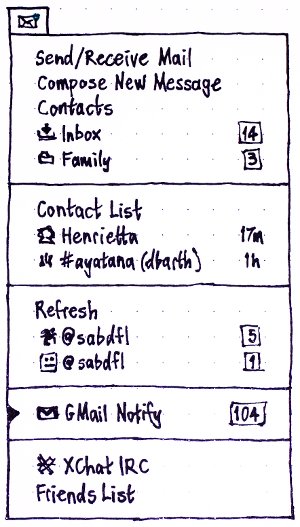
- Indicadores de sistema: No painel superior do Ubuntu, existem vários ícones que fornecem informações sobre o sistema, e até um que condensa informações e ações das aplicações de comunicação. A ideia para o Lucid Lynx é unificar e criar uma interface comum e consistente que permite agregar informações inteligentemente. Bem, uma imagem, mesmo que um mero rascunho, permite mostrar muito melhor o conceito:


- (Ainda) Mais melhoras nas notificações: As notificações do Ubuntu são cada vez mais um dos melhores sistemas de notificação atuais (quer visualmente quer em termos de facilidade de integração nas aplicações). Para o Lucid, as notificações estarão presentes com um novo modo, o modo “ocupado”. Por exemplo, se estiver vendo um filme em tela cheia, não será notificado de coisas triviais como email, mensagens de chat. Já avisos de bateria fraca ou de carga da bateria, esses sim, considerados "críticos" serão mostrados. Resta também esperar pela disponibilização de uma janela de configurações. Vamos esperar...
Projeto B-Sides: O projeto B-Sides é um projeto da comunidade que pretende facilitar a instalação de um leque de pacotes (codecs, utilitários, fontes, temas, Flash, aplicações multimédia, comunicação e de produtividade), que não estão incluídos no CD do Ubuntu, mas que são igualmente úteis e essenciais, complementando assim o sistema. Bastará instalar o pacote ‘b-sides’ e todas essas aplicações serão instaladas. Para mim que instalo várias vezes o Ubuntu, esta é uma fantástica novidade, que me permitirá poupar ainda mais tempo na instalação e substituir aquela enorme linha de comandos e colar no console. A lista completa de aplicações encontra-se aqui.

- Gnome 2.30: A versão 2.30 do ambiente gráfico Gnome trará melhoramentos gerais em todas as aplicações, incluindo o cliente de mensagens instantâneas Empathy, o gravador de disco Brasero, o leitor de documentos Evince (suporte a OCR, converter imagem em texto) e melhorias no visual dos ícones e no painel. A lista completa de objetivos, aqui.
- Linux Kernel 2.6.32: O Ubuntu 10.04 virá com a versão 2.6.32 do Linux Kernel, o que assegura maior estabilidade, maior rapidez e maior compatibilidade de hardware. Melhorias no gerenciamento de energia e na virtualização são também esperadas.
E são estas as grandes novidades do Ubuntu Lucid Lynx. Mais virão mais com o passar dos meses, e aqui no blog é certo que as mencionaremos. Se já quiser baixar o Ubuntu 10.04, vai ter que esperar até 29 de Abril, ou tentar o Beta (somente para os apressados!). Mas se nunca experimentou o Ubuntu, faça já o download do Ubuntu 9.10 Karmic Koala 
terça-feira, 22 de dezembro de 2009
Installing TTF FONTS in Ubuntu 9.10
After spending a few hours looking and trying out suggestions from various places on the Internet. An All User Install of TTF Fonts goes
like this:
sudo su
password
cd /usr/share/fonts/truetype
mkdir 500fonts
cd /home/user/Desktop/500fonts
cp -r *.TTF /usr/share/fonts/truetype/500fonts
exit
sudo fc-cache -fv (* note the space after the word cache)
password
after a few moments...
exit
exit
It looks at all the fonts in the Font Cache and re-installs them. So if you have a Windows Font CD of TTF Fonts, you can now use it in LINUX.
You can add the ones out of the list to the open office folder, in /usr/share/fonts/truetype/openoffice, and they should appear in
OpenOffice.
like this:
sudo su
password
cd /usr/share/fonts/truetype
mkdir 500fonts
cd /home/user/Desktop/500fonts
cp -r *.TTF /usr/share/fonts/truetype/500fonts
exit
sudo fc-cache -fv (* note the space after the word cache)
password
after a few moments...
exit
exit
It looks at all the fonts in the Font Cache and re-installs them. So if you have a Windows Font CD of TTF Fonts, you can now use it in LINUX.
You can add the ones out of the list to the open office folder, in /usr/share/fonts/truetype/openoffice, and they should appear in
OpenOffice.
quinta-feira, 3 de dezembro de 2009
Ubuntu 10.04 Starts for 10 Seconds
The growing adoption of the Linux operating system on netbook devices has compelled Linux distributors to focus on improving startup performance. Ubuntu 9.10, recently released, is one distribution where these improvements are particularly noticeable.
In a presentation at the Ubuntu Developer Summit in Barcelona, developer Scott James Remnant noted that boot time decreased from 65 seconds in version 8.10 to only 20 seconds in 9.10, codenamed Karmic Koala. This is already a substantial improvement, but he believes that there is still room for more aggressive optimization. Canonical, the company behind Ubuntu, will continue pushing the limits of boot performance. According to Remnant, the company aims to achieve a ten-second boot time next year for Ubuntu 10.04, the release that will follow after Karmic.
In a presentation at the Ubuntu Developer Summit in Barcelona, developer Scott James Remnant noted that boot time decreased from 65 seconds in version 8.10 to only 20 seconds in 9.10, codenamed Karmic Koala. This is already a substantial improvement, but he believes that there is still room for more aggressive optimization. Canonical, the company behind Ubuntu, will continue pushing the limits of boot performance. According to Remnant, the company aims to achieve a ten-second boot time next year for Ubuntu 10.04, the release that will follow after Karmic.
Assinar:
Postagens (Atom)

